Showing posts with label Kids and Nature. Show all posts

Sunday, August 30, 2009

Summer Highlights

Though autumn officially begins just shy of a month from now, I am ready-- ready for the cooler weather, fall planting and the fall semester of school (for the kids plus myself). Overall, this has been a satisfying summer... lots of family bonding and fun with friends.
Some lessons learned along the way these past few months:
The messier, the better (when the kids' entertainment is concerned, that is)...
There's always enough time to pull over and enjoy the view (& talk to a goat or two)...
You never know what you may come across on your travels (camels in CA?)...
Firefighters and fireworks are a dangerous combination...
You can never grow out of skinny dipping, pillow fights, or catching frogs, tadpoles & butterflies...
The best meals are improvised (and the more, the merrier!)...
Love knows no boundaries (just ask a preschooler)...
And, no matter how bumpy the road, the beauty's in the details.


"Climb the mountains and get their good tidings. Nature's peace will flow into you as sunshine flows into trees. The winds will blow their own freshness into you, and the storms their energy, while cares will drop off like autumn leaves."
--John Muir

Saturday, July 25, 2009

The Buzz (...on bees)

The latest Sunset magazine issue (August 2009) featured an article called "Hive Minds," and it's worth a trip to the grocery store if you aren't already a subscriber. The article isn't accessible online, but here's "the gist:"
"As honeybees around the world vanish, one Bay Area biologist is enlisting an army of backyard gardeners to help figure out why...the concept is simple: free 'Lemon Queen' sunflower seeds [are distributed] for people to plant in their yards. In return, once the flowers bloom, the recipients report back any bee-related activity. 'Sunflowers are easy to grow and wildly attractive to bees...You're basically handing over a thermometer that allows people to measure how their garden is doing.' [The Sunflower project] recently partnered with Cornell University on the Birds & Bees Challenge, which helps young people between the ages of 7 and 17 rediscover nature in their own neighborhoods, becoming amateur scientists, photographers, and artists."
Click here for more info.
Also, for avid gardeners and wannabe farmers, here's a blog worth following (it even includes more info on bees):
Sunset's
"We're writing about how we've used our garden expertise to grow just about everything we need, in a plot actually much smaller than a block—more like what most of us have at home: a suburban back yard. Then we're using our produce to cook a series of seasonal feasts. Last summer, we had our first dinner. Right now we're working on a winter garden, with feast to follow.
We're not just growing plants, though. To make our dinners more interesting (and tasty), we're raising chickens (for eggs). We've made beer, and wine, and vinegar. We're making cheese (from 'imported' milk, but who knows, maybe a cow is in our future) and olive oil and honey. We've even made salt (from ocean brine), because how can you cook without seasoning? If you're a DIY kind of person, someone who thinks that dinner starts with the earth, the sea, and a few animals, this blog (and our accompanying how-to guides) can you help you put together your own made-from-scratch meals.
To follow the adventures of Teams Garden, Kitchen, Bee, Chicken, Beer, Cheese, Wine, Vinegar, Salt, and Olive, see the links under 'Categories' ... We'll probably be adding more projects as we move into different seasons."
And, for die-hard nature lovers, a "bee books" link for "those charmed by bees" (click here).

Friday, May 29, 2009

Confused Carrots


Above is an example as to why good dirt is essential for a successful kitchen garden. Unfortunately the dirt in our garden consists mostly of silty clay.
When grown in ideally loamy soil, carrots don't turn out so... freakishly beautiful.

Saturday, May 23, 2009

Pests welcome!

Attention all cabbage loopers, army worms, webworms, diamond back moths, grasshoppers, slugs, aphids, fungal gnats, and all other damaging insects! Available vacancy at The Fox Den Garden; dining accommodations included.

I don't know which got here first (us or them), but anything chewing up our garden will either be food for praying mantises and ladybugs, or disposed of organically. Also, my 4-year old son, Rigel, likes adding new caterpillars to his bug jar...he's got quite the collection of cabbage worms and loopers.
When I think about it, nearly each and every plant in our vegetable garden was selected by myself or the kids for its enticing seed packet, then nurtured, obsessed over and observed every day since. We deserve to be a bit overprotective, right?
In other words, bring it on, bugs and worms.
Exception: Monarch caterpillars. Ever since our milkweed has bloomed, we've been keeping an eye out for those tiny monarch caterpillar eggs found hidden on the bottom of of the leaves. We finally found a few this morning! Last year we raised about 15 monarchs from caterpillar to butterfly outside our kid's window, and it was fascinating.
Adult caterpillars left behind only the stems of each plant--I had to buy more milkweed just to accommodate their voracious appetite!
This year we'll just be observers
(and hope we planted enough milkweed).
The best part of the project was releasing the butterflies...after their wings dried out (and after Mommy put down the camera).

I tried not to pay attention to the lovely black swallowtail butterfly that was laying eggs in our carrot greens this month, but of course--our carrot bed has now become a swallowtail butterfly habitat. I've counted 2 caterpillars, so far.

P.S. check out this charming Monarch butterfly on Etsy... it's handmade wool felt and can be a pin or a hair clip. I'm trying hard not to buy it, but I don't know how long that's going to last.

photo of felt butterfly credit: Etsy

Thursday, May 7, 2009

Seasons on an Organic Farm

"An elegy to the land and to the creatures who inhabit it...the book is also a gardener's bible." --Anne Raver, THE NEW YORK TIMES
Also, check out this interview of the author.

Thursday, April 30, 2009

Where's the Ladybug?


There's a ladybug in my broccoli... quick, take a picture!


Join the nationwide hunt for ladybugs... specifically, the elusive 9-spotted ladybug, which was once very common but has become extremely rare. In 2006, a 9-spotted ladybug was found in the North Eastern U.S--the first to be "spotted" in 14 years!


The National Science Foundation has granted Cornell University $2 million for the Lost Lady Bug Project, which encourages children and adults to go out and capture (or observe) ladybugs, photograph them, and then email the photos to Cornell University. Researchers will use these photos to help determine what species are still out there and how many are left. Quoting Cornell's Lost Ladybug Project website: "This is the ultimate summer science project for kids and adults! You can learn, have fun and help save these important species."

Wednesday, April 29, 2009

The Backyard Homestead

Check out this awesome discovery by my mom (copied and pasted from the publisher's website):
The Backyard Homestead
Edited by Carleen Madigan

With just a quarter acre of land, you can feed a family of four with fresh, organic food year-round. This comprehensive guide to self-sufficiency gives you all the information you need to grow and preserve a variety of vegetables, fruits, herbs, nuts, and grains; raise chickens for eggs and meat; raise cows, sheep, and goats for meat or milk; raise pigs and rabbits; and keep honey bees. Simple instructions make it easy to enjoy canned, frozen, dried, and pickled produce all winter; use your own grains to make bread, pasta, and beer; turn fresh milk into delicious homemade yogurt, butter, and cheese; make your own wine, cordials, and herbal teas; and much, much more. It truly is possible to eat entirely from your backyard.
Cover photo and summary credit: Storey Publishing

Sunday, April 19, 2009

Strawberry Fields Forever


So... our strawberry patch is producing its first bounty of berries, and though we've found some blossoms and actual strawberries (three berries, to be exact)--it's not exactly picking season for us, yet. But, the U-pick strawberry patch in Carlsbad is open to the public as of last week, and it provides a perfect alternative for impatient little gardeners who are eager to harvest their crops.


Tuesday, April 7, 2009

Rigel and Iz are keeping an eye on our "strawberry patch"; they know exactly where our first two baby green strawberries are ripening. Therefore, how could this cute little pouch necklace not catch my eye?


The wings are a pouch, and the doll is a removable caterpillar... too cute.

doll necklace photos from Etsy

"Never enough thyme..."


I never would have thought that I'd be so passionate about gardening, yet here I am feeling like the sun goes down each day before I'm done fussing over our new vegetable garden. Except it's not strictly a vegetable garden, since we've got melons, strawberries, blueberries, artichokes, asparagus, herbs and spring bulbs mixed in with it all. Yesterday we added a nectarine tree to our "orchard." It'll be a couple years or more before we'll be harvesting any fruit from our trees, but when we do I'm planning on mastering nectarine pie (is there such a thing?). There's also something about growing most of the garden from seed--the nurturing and anticipation of it all explains how easily gardening can become more than just a hobby.
P.S. I love this soil (not because of the name, even though it's cool)...it's "super-dirt" for your plants. Earth-worm castings, bat guano, and a lot of other nitty gritty ingredients make this brand's soil my favorite. Their dry mix organic fertilizers are great, too.

Get a Can-O-Worms

I am loving our worm farm. Stumbled upon at the Mission Hills nursery, this contraption can hold up to 20,000 worms. Nutrient-rich "worm tea" pours out a spigot at the bottom after filtering through 3 levels of worm castings. It's a neat-and-clean-hands-free method of worm farming. Old paper, kitchen scraps and coffee grinds get recycled into "vermicompost" by redworms (similar to earthworms). The sole purpose of these worms is to eat, poop, and reproduce whilst compost and worm tea is harvested from this container. I dispose of my vegetable and fruit scraps into a covered ceramic pot on my kitchen counter, which I dump into the Can-O-Worms at the end of each day. Some people keep this worm farm inside (yuck!)--in their kitchens (double yuck!)--but our worms are doing just fine outside, thank you.

Sunday, March 8, 2009

Our first garden


This is our first attempt at a vegetable garden, and so far it has been a lot of fun. We've got a raised planter box built (with an upper and lower bed), a "flower teepee," and two new trees. So far, our seedlings are nestled in eight seed trays --that's 72 seedlings per tray! I don't even want to do the math. Just going to keep my fingers crossed that we'll have enough room for it all.

Tuesday, February 3, 2009

Chula Vista Nature Center


This is one of those places that provides a new and unexpected experience each time we visit... lets hope it stays open for another 25+ years (it has been recommended for complete closure by the Chula Vista City Council due to lack of community funding... Click here for info on the center's uncertain future...)

We've experienced everything from close encounters with raptors (as seen above) to discovering a hummingbird nest in the brush surrounding the building:

Friday, January 30, 2009

First Family Garden


This spring the Fox Den will attempt to grow our first garden--complete with fruits, veggies, herbs and... (drum roll, please) a tent. We've got the bamboo stakes, the climbing vines, seed packets, and organic soil. We are planting our seeds in biodegradable egg cartons we've been hoarding over the last few months. Next up: digging up a corner of our lawn (renting a roto-tiller sure sounds tempting) to replace it with compost, manure and whatever else the local nursery advises. I'm also nudging Chief Fox to get a compost container set up (his reluctance on this is due to his fear of attracting roaches... should that be a concern?).

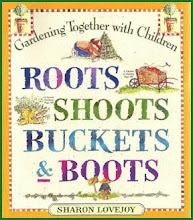
photo credit: Roots, Shoots, Buckets and Boots, copyright 1999 by Sharon Lovejoy

Posted by Picasa

Sunday, January 4, 2009

Sledding


Since half of San Diego hits the malls for those after-Christmas-day sales, we decided to go sledding that day instead. Pine Valley has a great little diner we like to visit every now and then for malts and melts called Major's...and Mt. Laguna is where we found all the snow--as well as the other half of San Diego. The sledding traffic was so thick that it felt and sounded like we were at a stadium event!
Play the video below for a glimpse of Rigel surfing the snow...


Tuesday, December 16, 2008

Butterflies for the Holidays


We brought our milkweed "habitat" inside during the rainstorm, and 4 butterflies emerged from their cocoons (chrysalis). Rather than set them loose out in the rain and cold, we kept them indoors while we decorated the Christmas tree. The next morning, Rigel, Izzy, and Maz let them go in our front yard. The excited squeals of delight erupting from the kids (as their fingers got tickled by the "scratchy butterfly legs") was the best part of this whole experience.

Tidepooling!


Below: Shanna, Ava, & Maz (lft to rt)


Below: Izzy, Maz, & Rigel (lft to rt)

The tides were low during mid-day hours for the first time in over 3 months, so we headed out to Point Loma with some friends. Lucky for us, Dan was able to join us as well. Armed with buckets, we happened upon sea anemones, hermit crabs, lots of different kinds of sea weed, sea snails, and clusters of goose-necked barnacles. Rigel declared it was time to go home on account of there not being any sea stars, but we stuck it out and picnic'ed on the rocks.
(For info on the tides, go to http://www.tidelinesonline.com/)

Tuesday, December 2, 2008

Butterfly Window


We had 7 monarch cocoons (chrysalis) waiting for us when we got back from our Thanksgiving trip up north... there were still a couple "late bloomers" (see below) and a whole bunch more babies that had hatched.


This is one of the kids' windows, and has proven to be a perfect "butterfly raising" location. After a few mistakes, I've found the best way to raise your own monarchs is outside. Keeping the pots inside a larger storage bin corrals all the escapees (numerous caterpillars dropped off the milkweed until I figured this part out). Also, when placed right outside the window, it allows the kids to have some eye-level observation time without the hands-on worries (just close the window). It won't be long until we see some butterflies!


(Click here for more info on raising monarch caterpillars, and here for postings on Gulf Fritillary butterflies)

Holiday Bulbs


Posted by Picasa
Rigel and Izzy enjoy peering into this bulb jar, and teaching Daddy how "the green part will grow taller and taller, and then there will be flowers...the bobes need water and sunshine...there's their wrooots!" I love this jar--this will be the 3rd year it has been taken out of the garage for display. It has a raised plastic "frog" plate on the bottom, so the growth of a bulb can be observed from the roots to the tips of the flowers...I'm pretty sure these are still available at Costco (fully loaded with flowering blooms).
P.S. It's not too late to get around to planting all spring-flowering bulbs... and amaryllis bulbs can bloom for the holidays if they get in the ground today (or tomorrow or the next day).

Friday, November 7, 2008

...Still More Butterflies to Arrive!

You’d think I would have had my fill of butterflies after successfully raising the Gulf Fritillary caterpillars we stole from Grandma Lana’s garden. Nope. I decided we were not done yet. While passing time at the nursery catty corner to Rigel and Izzy’s swim class, we happened upon a supply of milkweed-- and I couldn’t resist. It was a struggle not to squawk in protest when the cashier started to pluck off supposed aphid-infested leaves—did she know that on the leaf she just picked off a baby monarch caterpillar was crawling across? I silently retrieved the discarded leaf and tucked it safely into one of my three containers of milkweed. Hence, I have determined that raising butterflies requires a measure of obsessive-ness. All is worthwhile once the finished product emerges from its cocoon and perches upon your finger (or better yet, your little one’s fingers).


Above left: caterpillars hiding amidst the flowers. Above right: a tiny monarch egg, which turns dark green when it is about to hatch.

How To Raise Monarch Caterpillars
We attempted to raise monarch caterpillars last year, and gave up after many failed attempts. I think the best way to go is not to raise them in vented containers indoors as we did, but to observe them outdoors. Proper ventilation is a must, and so this time around we have our milkweed containers perched outside the kids' window. Milkweed is the only plant monarch butterflies lay their eggs upon, and thus the only plant monarch caterpillars eat. Not all nurseries carry it. Once you find some, be sure no pesticides were administered, or the likelihood of finding caterpillars on your plant is slim to nil. Look on the undersides of the leaves and inside the flower clusters for eggs and teeny caterpillars. If you are interested in raising your caterpillars indoors, visit http://www.glorious-butterfly.com/raising-monarchs.html for in-depth instructions. Otherwise, just place your containers outside in a safe spot (direct sun is fine), and observe as the caterpillars develop from chrysalis to butterfly!