Showing posts with label Green Gab. Show all posts

Saturday, August 29, 2009

...the last of our spring garden...

"At the heart of every garden is the perennial cycle that I hesitate to name, 'it is so near to the heart,' of the death and rebirth. Mythologies and cottage wisdom have always linked the span of a human life, or incarnation, with the mysteries of seasons and the soil...my account of life lived on a particular farm is a response to the gesture of a sea breeze or the slap of a rough wind, a language more clearly voiced by catbird or redwing in the cedars, or by the miniature English robin, territorial and eloquent, who would settle on the hilt of my cliff shovel, tiny talons to steel. In that instant, a word appears, as natural as butterfly weed or nettle. And I hear the [ocean] strike sand particle and rock, part of the ground we share, eventual soil." --Scott Chaskey


From that:


To this:

"Autumn is a second spring where every leaf is a flower. "

--Albert Camus


It's about time to clear out the spring vegetables and begin preparing the soil for the cool season crops of autumn. My first experience getting my hands in the dirt proved to be fulfilling to the soul and mind. Here are some tips I learned from trial, error and research:

Organic Vegetable Gardening 101

(according to the Fox Den's experiences this last spring)

Good dirt is essential. Loamy, nutrient-rich soil is the key ingredient to a successful garden (along with the basic essentials of fertilizer, compost, and mulch, there are some other optional soil amendments--such as lime, potash, gypsum, etc.--available as well to prepare your vegetable beds). You can purchase your soil, or you can prepare it yourself...just depends on how much money you want to spend.

Proper seed spacing is almost as important as proper soil--especially to root vegetables such as carrots, radishes, and beets. Click here for a glimpse of improperly spaced root vegetables grown in silty-clay soil (poor-draining soil).

Companion planting is both complicated and simple--it remains an experiment of balancing well-practiced methods of companion planting with your own.

Planting companion flowers within your vegetable garden is as aesthetically pleasing as it is beneficial to the success of your garden. Interweaving flowers such as marigolds, alyssum, yarrow, hyssop, borage, sunflowers and calendula into your vegetable beds is a multi-functional arrangement (which benefits the birds, bees, flowers, trees and you). Alyssum and chamomile are frequent re-seeders; they help break up the soil and add to the organic content. Chamomile activates the composting process, and encourages increased essential oil production for strong herbs such as lavender and rosemary. Hyssop, marigolds, and yarrow attract hoverflies, which eat aphids. Marigolds can be nematocytal if grown as a crop cover and tilled in before the plants get too large; they are also believed to deter pests.

Cucurbits (melons & squash) and legumes (beans, peas & sweet pea flowers) are susceptible to mold. Prevention includes removing all portions of the infected plant at first sign of mold growth, disposing of all moldy leaves and stems (do not recycle to mulch or compost). Spray tops and undersides of leaves, stems and soil with soapy solution (consult local nursery for best advice). Try not to water plants directly (water soil only). Click here to see a variety of environmentally-friendly pest control products.

Brassicas / cruciferous vegetables (i.e., cabbage, broccoli, brussel sprouts), leafy greens (ie., lettuce & spinach), and herbaceous perennials (i.e., strawberries & artichokes) are vulnerable to pests such as cutworms, armyworms, and cabbage loopers. These pests can be found on the undersides of leaves and hiding just below the surface soil at the plant base. Use a safe organic pesticide (consult local nursery), &/or apply microscopic nematodes to the soil &/or purchase biocontrol insects such as mini wasp pupae.

Poorly-drained soil &/or over-watered soil makes garden beds vulnerable to fungus gnats. These gnats thrive in moist environments, and can spread rapidly. The larval stage of fungal gnats can damage root systems and spread plant disease. Excess plant debris &/or newly added compost/mulch can attract fungus gnats, so keep beds free of excess debris (and use "older" well-broken down compost, supposedly). Combat with organic insecticides (consult local nursery) &/or biocontrol agents (such as rove beetles). Do not mulch beds with poorly-draining soil (i.e., silty clay) which is watered frequently.

Tomatoes are susceptible to yellow leaf curl virus. This disease can devastate your tomatoes! Prevent yellow leaf curl virus by planting tomatoes from seed, not using soil or beds which grew previously infected plants, controlling whitefly infestations with organic insecticide or biocontrol agents (whiteflies can contribute to spreading of the plant disease), never watering the leaves and stems of the tomato plants directly (this can contribute to spreading from plant to plant), and removing any infected portions of the plant and quarantining it from the rest of the garden. Also, spray a water & milk solution on the top and undersides of the tomato leaves, as well as directly into the soil regularly. Spray beneficial nematodes into the soil.

Ladybugs, hoverflies, praying mantis, lacewings, nematodes and bumblebees are just a small portion of the vast array of beneficial garden insects available for purchase online (and at some local nurseries / supply stores). Use of beneficial insects to combat garden pests is a green way to help keep your plants pest-free and aide crop pollination... Click here to find a very thorough resource on these biocontrol agents.

Tomatoes are host plants to hornworms (tobacco &/or tomato hornworms), which eat the leaves / stems of the tomato plants. Hornworms are the caterpillars which metamorphosize into sphinx moths (hawk moths). Sphinx moths scout out host plants on which to lay their eggs... learn how to identify sphinx moths, and remove them from your garden (transplant elsewhere? :) Sphinx moths are attracted to porch lights at night, and are often mistaken for hummingbirds during the day. Remove the sphinx moths from your garden, and you may not have to worry about picking hornworms off your tomato plants later... it's worked for me so far. (Confession: these large hummingbird-like moths are toys to cats, who will play with them until the moths eventually meet their doom.)

Composting can be addicting! How can a gardener not find appeal in creating one's own nutrient-rich plant medium from recycled kitchen scraps? Added bonus: vermicomposting (i.e., worm tea & worm castings).

Fertilizers are great for maximizing flavor, yeild and size of your vegetables. Click here for a great organic fertilizer. Work out a feeding schedule, and try and stick to it regularly. These liquid fertilizers applied with a folliar pump spray are my favorite: FoxFarm Big Bloom, Tiger Bloom and Grow Big.

Nothing compares to flowers freshly cut from your own garden supply... especially if they are your favorite variety. You can never have too many tomatoes, squash, beans and other good things... gardening is a great way to get to know your neighbors (...sharing is good)!

Try letting some of your flowers, herbs, and legumes go to seed, then clip / collect them when they are dried on the stems--this works especially well for sweet peas, cilantro, dill and beans. If seed pods are not entirely dry, clip and set out in a dry location (in the garage, near the window...) before hulling and storing (plastic baggies and recycled glass jars with lids work well for storage, as long as they are air-tight and dry). Seeds are supposed to last for at least a year, but productivity decreases with time.

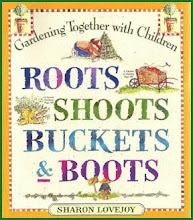
Research, seek out, and explore gardening online as well as in the library... there are a lot of great resources out there (Online: You Grow Girl, Urban Homestead, The One Block Diet...Books: Roots, Shoots, Buckets & Boots, This Common Ground, The Backyard Homestead)

Saturday, July 25, 2009

The Buzz (...on bees)

The latest Sunset magazine issue (August 2009) featured an article called "Hive Minds," and it's worth a trip to the grocery store if you aren't already a subscriber. The article isn't accessible online, but here's "the gist:"
"As honeybees around the world vanish, one Bay Area biologist is enlisting an army of backyard gardeners to help figure out why...the concept is simple: free 'Lemon Queen' sunflower seeds [are distributed] for people to plant in their yards. In return, once the flowers bloom, the recipients report back any bee-related activity. 'Sunflowers are easy to grow and wildly attractive to bees...You're basically handing over a thermometer that allows people to measure how their garden is doing.' [The Sunflower project] recently partnered with Cornell University on the Birds & Bees Challenge, which helps young people between the ages of 7 and 17 rediscover nature in their own neighborhoods, becoming amateur scientists, photographers, and artists."
Click here for more info.
Also, for avid gardeners and wannabe farmers, here's a blog worth following (it even includes more info on bees):
Sunset's
"We're writing about how we've used our garden expertise to grow just about everything we need, in a plot actually much smaller than a block—more like what most of us have at home: a suburban back yard. Then we're using our produce to cook a series of seasonal feasts. Last summer, we had our first dinner. Right now we're working on a winter garden, with feast to follow.
We're not just growing plants, though. To make our dinners more interesting (and tasty), we're raising chickens (for eggs). We've made beer, and wine, and vinegar. We're making cheese (from 'imported' milk, but who knows, maybe a cow is in our future) and olive oil and honey. We've even made salt (from ocean brine), because how can you cook without seasoning? If you're a DIY kind of person, someone who thinks that dinner starts with the earth, the sea, and a few animals, this blog (and our accompanying how-to guides) can you help you put together your own made-from-scratch meals.
To follow the adventures of Teams Garden, Kitchen, Bee, Chicken, Beer, Cheese, Wine, Vinegar, Salt, and Olive, see the links under 'Categories' ... We'll probably be adding more projects as we move into different seasons."
And, for die-hard nature lovers, a "bee books" link for "those charmed by bees" (click here).

Saturday, July 18, 2009

Adorably Green


Hand-made and crafted of wool felt--doesn't get much cuter than this! Click here for more info.

Thursday, May 21, 2009

Stainless Steel Baby Bottle.

My kids have been off bottles for a while now, but if I had a newborn and weren't able to breastfeed %100 of the time, I would definitely consider these stainless steel bottles. They are BPA, PVC and phthalate free (harmful chemical compounds found in plastic). Lots of different designs are available, and they are lightweight and non-leaching. I'm impressed, and maybe missing newborn motherhood a little bit. But, I have enough to smile about with my two little ones!
photo from: www.organickidz.ca

Catch the sun in a mason jar!

At first when I came across this product, I thought it was charming idea, (though the reviews on Amazon.com were pretty disappointing). It's basically a genuine mason jar with an inner solar light. It holds a soft, sunny-colored glow at night (and charges in the sun during the day).
These would be great for outdoor summer evenings, so why not try and make them ourselves?
It's pretty easy--just purchase a mason jar with attached lid (ex: Ikea), some glass frosting spray, cheap solar garden light, and some Blue Tak. Click here for the tutorial.

Saturday, May 9, 2009

Crack open this Mother's Day gift!


Rather than the conventional Mother's Day flowers, I got my mom these Egglings, in spirit of her new baby chickens (all 5 of them!)... Mom's got 2 yellow chicks, 1 black chick, and 2 brown chicks that lay blue eggs. I don't remember the official names of the breeds she selected, but they sure are cute!

Thursday, May 7, 2009

Seasons on an Organic Farm

"An elegy to the land and to the creatures who inhabit it...the book is also a gardener's bible." --Anne Raver, THE NEW YORK TIMES
Also, check out this interview of the author.

Thursday, April 30, 2009

Where's the Ladybug?


There's a ladybug in my broccoli... quick, take a picture!


Join the nationwide hunt for ladybugs... specifically, the elusive 9-spotted ladybug, which was once very common but has become extremely rare. In 2006, a 9-spotted ladybug was found in the North Eastern U.S--the first to be "spotted" in 14 years!


The National Science Foundation has granted Cornell University $2 million for the Lost Lady Bug Project, which encourages children and adults to go out and capture (or observe) ladybugs, photograph them, and then email the photos to Cornell University. Researchers will use these photos to help determine what species are still out there and how many are left. Quoting Cornell's Lost Ladybug Project website: "This is the ultimate summer science project for kids and adults! You can learn, have fun and help save these important species."

Wednesday, April 29, 2009

The Backyard Homestead

Check out this awesome discovery by my mom (copied and pasted from the publisher's website):
The Backyard Homestead
Edited by Carleen Madigan

With just a quarter acre of land, you can feed a family of four with fresh, organic food year-round. This comprehensive guide to self-sufficiency gives you all the information you need to grow and preserve a variety of vegetables, fruits, herbs, nuts, and grains; raise chickens for eggs and meat; raise cows, sheep, and goats for meat or milk; raise pigs and rabbits; and keep honey bees. Simple instructions make it easy to enjoy canned, frozen, dried, and pickled produce all winter; use your own grains to make bread, pasta, and beer; turn fresh milk into delicious homemade yogurt, butter, and cheese; make your own wine, cordials, and herbal teas; and much, much more. It truly is possible to eat entirely from your backyard.
Cover photo and summary credit: Storey Publishing

Sunday, April 19, 2009

Strawberry Fields Forever


So... our strawberry patch is producing its first bounty of berries, and though we've found some blossoms and actual strawberries (three berries, to be exact)--it's not exactly picking season for us, yet. But, the U-pick strawberry patch in Carlsbad is open to the public as of last week, and it provides a perfect alternative for impatient little gardeners who are eager to harvest their crops.


Saturday, April 11, 2009

Naturally Convenient

Currently, I dispose of all my kitchen scraps in a covered ceramic bowl, but this bamboo compost pail looks a lot more convenient. It comes with charcoal filters to eliminate odors, and there is an inner liner that is removable and dishwasher-safe.
P.S. Bamboo is a sustainable resource (and can grow up to 4 feet per day!)
photo courtesy of amazon.com

Friday, April 10, 2009

Laundry List

photo credit: positively feminine

Being that I'm a stay-at-home-mom, it would seem that I have tons of time on my hands and should be ready and willing to take on all domestic responsibilities. BUT....if I could take one thing off my daily "To Do" list, it would be laundry. It's time consuming and never ending, and maybe if the clocks were turned back to the fifties and clotheslines were still relied upon (and if we had a sprawling lawn with lots of trees like the above sunshine-y picture), laundry wouldn't be so bad. Or, maybe I'm just a tad lazy and should face the facts: laundry is the bane of my existence and it is not going to go away!

Now, of course there are more worldly concerns than this mommy's laundry woes: our weak economy... water shortages... global warming... BUT, lets just say I could spoil myself every now and then... here's what I would do (hint, hint): hire this local home laundry service to pick up our family's laundry any time I felt a break was in order, or if, say, Mother's Day was approaching. Said service picks up your laundry, inspects each individual garment for stains, cleans it with Eco-friendly detergents and softeners, professionally folds it, then delivers it all to your door step within 24 hours of pick up (click here for pricing, which is pretty good, if you ask me). So, doesn't it make sense for all interested parties to unite and support our local businesses, conserve water (sort of), and go green by hiring this local home laundry service?

Tuesday, April 7, 2009

Get a Can-O-Worms

I am loving our worm farm. Stumbled upon at the Mission Hills nursery, this contraption can hold up to 20,000 worms. Nutrient-rich "worm tea" pours out a spigot at the bottom after filtering through 3 levels of worm castings. It's a neat-and-clean-hands-free method of worm farming. Old paper, kitchen scraps and coffee grinds get recycled into "vermicompost" by redworms (similar to earthworms). The sole purpose of these worms is to eat, poop, and reproduce whilst compost and worm tea is harvested from this container. I dispose of my vegetable and fruit scraps into a covered ceramic pot on my kitchen counter, which I dump into the Can-O-Worms at the end of each day. Some people keep this worm farm inside (yuck!)--in their kitchens (double yuck!)--but our worms are doing just fine outside, thank you.

Monday, December 1, 2008

Squeaky Green


(I may be the last mom to have discovered this kid's line from Method, yet I still felt it worthy of a blog posting.)


Until now, I've never really been satisfied with the wide assortment of bath and body products available for kids. Either there were too many chemicals (i.e., methyl / ethyl / propyl parabens, sodium laureth sulfates/-ites, etc.) or too many organic extracts (i.e., lavender or tea tree extract/oil which are up for debate as possible endocrine disruptors)... This 3-in-one body wash, shampoo & conditioner for kids is great--smells and feels soft. The best part: ... 99% natural ingredients and affordable...part of Method Baby & Kids Squeaky Green hair & body line. I've also been pleased with the baby lotion and the bubble bath...Now, why am I using my precious late-night down time to blog about this? Because as a mom, this is the kind of stuff that raises an eyebrow (or two).

Friday, November 14, 2008

Thirsty Moms On the Go

Between the weekly dance, swim and karate classes (not to mention playgroup and t-ball), my kids keep me on-the-go quite often. Okay, perhaps I'm the one keeping them busy, right? I am pretty picky about what I feed my kids, and thus tend to pack them the necessary on-the-go snacks and drinks. Nevertheless, it is often tempting to utilize the strategically located Starbucks drive-thrus for myself ("ahem: one Starbuck's sweetened venti Passion Iced Tea, please..."), since my motherly instincts seem not to include the ability to nurture myself. I am trying to leave the house each morning well-prepared and therefore less likely to detour into these convenient drive-thru pit stops that pop up into my periphery during my weak moments of the day ("...and a Turkey Pesto sandwich, please... thank you!"). Here's one of my remedies for thirsty Moms on the go:
Check out these ice cube trays from Ikea--

These floppy rubber molds come in several different shapes, but I like these 6" long "sticks" best...


Imagine freezing some fresh-squeezed juice from some of these:


...with a single julienned piece of this:


...and perhaps a crushed sprig of this:


...Add one of those ice "sticks" to water inside this on your way out the door:


...and viola! You've got water on-the-go (green*ly contained), worthy of serving at a day spa.
(And, more health-conscious than your average bottle of water. Click here for more info).


Photos courtesy of Google.com

Thursday, November 6, 2008

Great Green Blog

Our Green Nest
Here is a great blog for families interested in a green lifestyle. The site includes lots of info and resources on green living, recycling, natural homes and gardens, and raising babies "green".

http://ourgreennest.blogspot.com/